

The concept of a sales pipeline may seem straightforward at first glance - moving deals through various stages until they are either closed or lost. However, as your pipeline reaches a significant number of deals (typically starting from 50), it becomes easy to overlook crucial actions that are essential for maintaining a healthy pipeline with a substantial amount of quality opportunities to help you reach your sales quota. Below are the main rules to follow in your day-to-day sales activities to ensure you reach the best results.
Design a Clear and Logical Sales Process:
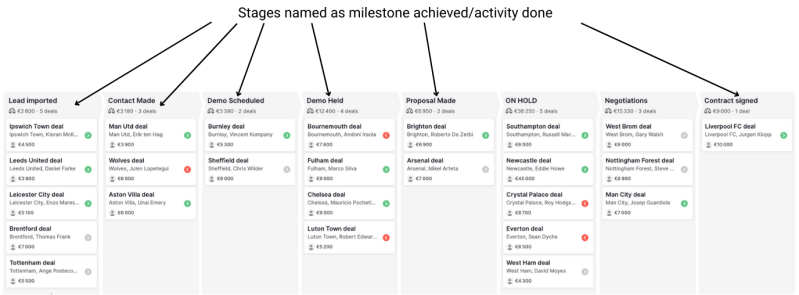
- Establish a logical sales process with well-defined pipeline stage names that minimize the chances of salespeople making errors when assigning deals to the correct stage. For instance, name stages to reflect milestones achieved, such as "Lead Imported," "Contact Made," and "Proposal Sent." This approach reduces confusion and ensures accurate placement of deals within the pipeline.
Measure Key Sales Metrics:
- Regularly track essential sales metrics, including the average sales cycle length, conversion rate, and average deal size. Analyzing these metrics provides valuable insights into the health of your pipeline and helps to answer critical questions like ''Is this deal big or small comparing to my rest pipeline'', ''How fast such type of deal usually gets closed'', How many new leads do I need to add to my funnel to hit my sales quota in 6 months''
Define Qualified Deals and Forecast Accurately:
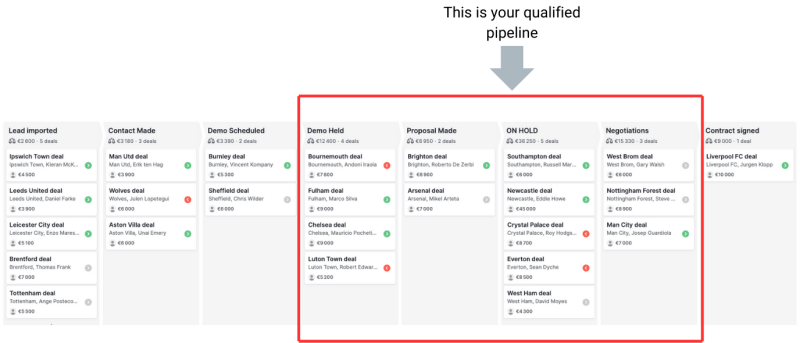
- Distinguish between marketing qualified leads (MQLs) and sales qualified leads (SQLs) to classify and prioritize deals effectively. Check my post about key information to obtain to consider the deal qualified. When forecasting potential revenue, focus on SQLs exclusively as they have met internal qualification criteria and are more likely to convert into customers. Avoid relying on the total pipeline value (MQLs+SQLs, which may include unqualified deals and lead to unrealistic revenue projections.
Track Lost Deals and Revisit Them:
- Monitor reasons for lost deals and periodically revisit them to gain insights into why prospects chose not to move forward. Create a list of common reasons for lost (usually 5-7), such as ''Chose a competitor,'' ''Too expensive'', or ''No-decision'', and use this feedback to refine your sales process and product strategy as this feedback usually makes a difference.
Establish Guidelines for Deals On Hold:
- Define clear criteria for placing deals in the "On Hold" stage and set limits on how long a deal can remain in this stage. The "On Hold" stage should be reserved for qualified deals that are temporarily stalled due to external factors. This stage tends to accumulate a lot of deals with no clear motion forward. Avoid using this stage as a catch-all for stagnant deals, as it can lead to false expectations and hinder accurate pipeline forecasting as most of the deals that spent too much time in the ''On Hold'' stage eventually lose momentum and go to Lost. What you can do:
- define a 90 days maximum limit for deals to stay in the ''On Hold'' stage;
- make it mandatory to have a next step planned in every deal in the ''On Hold'' stage;
- set a notification in your sales CRM system flagging deals which have not had any activity for X amount of days (rotten deals)

By following these key rules and best practices for managing your sales pipeline, you can enhance efficiency, optimize deal flow, and improve overall sales performance. Maintaining a well-structured and proactive approach to pipeline management will enable you to stay focused on high-quality opportunities and get you closer to achieving your sales targets.
If your pipeline management process needs a review or an extra pair of eyes, give me a shout.